


Philosophy For Children
Developing Critical Thinkers, Reflective Learners and Respectful Citizens
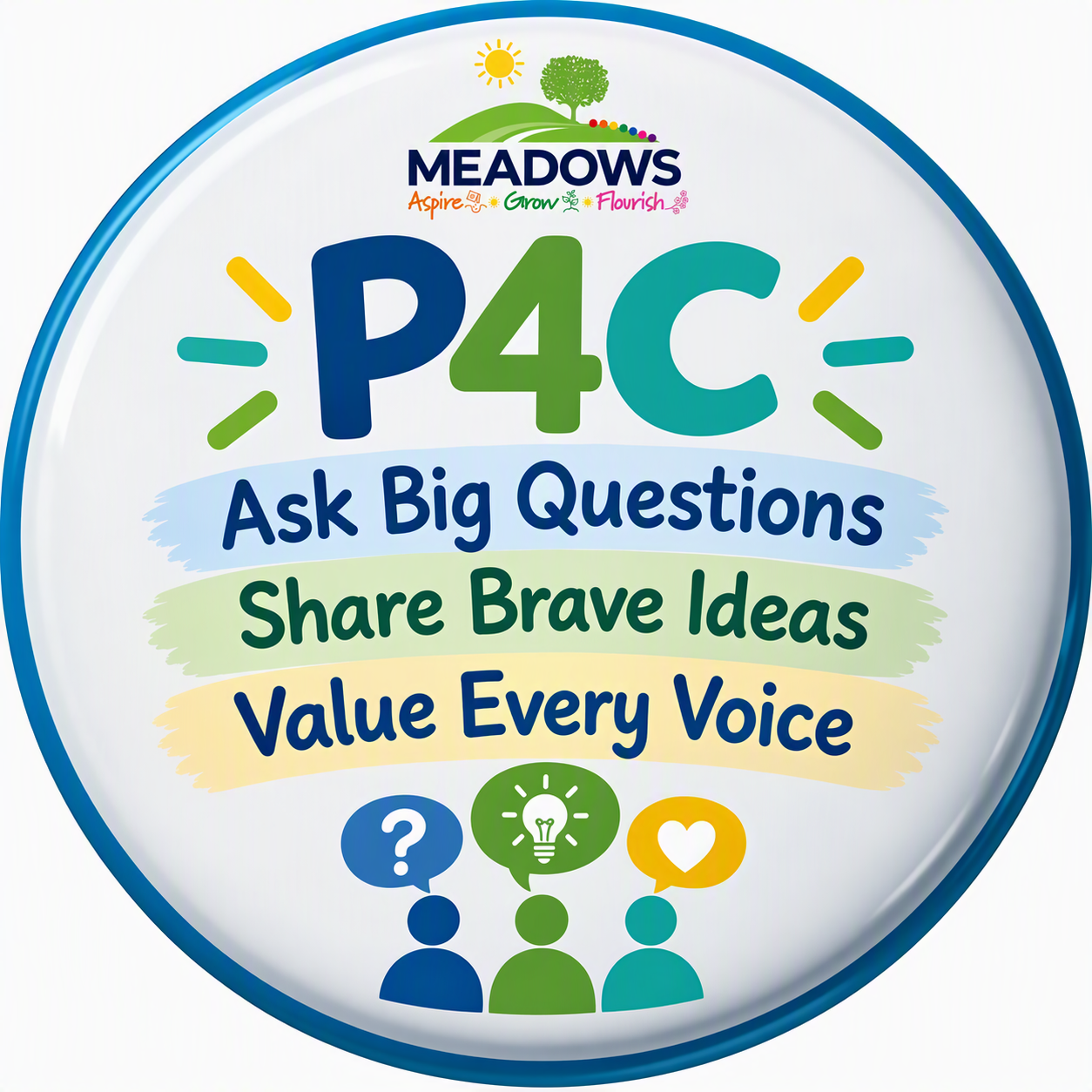
What is Philisophy for Children?
Philosophy for Children and Communities (P4C) is an educational approach that encourages children to think critically, creatively, collaboratively and with care. Through carefully planned discussions and enquiries, children explore "big questions" about themselves, their relationships, their community and the wider world.
P4C provides children with opportunities to question, reason, analyse and justify their thinking in a safe and respectful environment. It is built upon the core principle that:
"All views are valid. All values are valued."
Through philosophical enquiry, pupils learn that there may not always be one correct answer and that listening to, understanding and respectfully challenging different perspectives is an important part of learning and life.
What is the intent of P4C at Meadows?
By embedding Philosophy for Children across the school, we aim to nurture curious, reflective and open-minded learners who can confidently explore complex questions, appreciate different perspectives and contribute positively to an increasingly diverse and interconnected world.
At Meadows, our aim is to develop children who:
- Think critically and independently- A trust wide aspiration.
- Ask thoughtful questions and seek deeper understanding.
- Listen actively and respectfully to others.
- Reflect on their own beliefs and viewpoints.
- Demonstrate tolerance, empathy and acceptance.
- Become confident communicators.
- Understand and appreciate diverse cultures, experiences and perspectives.
- Develop into responsible, values-driven citizens who contribute positively to society.
P4C strongly supports our existing Learning Powers by promoting:
- Curiosity
- Resilience
- Independence
- Reflection
How is P4C Implemented at Meadows?
Meadows has begun embedding P4C across the curriculum as part of our commitment to developing deep thinking and meaningful discussion within all areas of learning.
Many of the principles of P4C are already present within our curriculum. Staff regularly use resources such as:
Golden Read
Books and stories that provoke discussion around moral dilemmas, right and wrong, fairness and justice.
Picture News
Current affairs resources linked to:
- Global issues
- British Values
- Protected Characteristics
- Children's understanding of the wider world
These resources have helped pupils to:
- Think critically about issues that affect society.
- Consider the viewpoints and experiences of others.
- Develop tolerance and acceptance of differing beliefs and opinions.
- Understand why respectful disagreement is important within a democratic society.
Key Areas of Learning
The P4C Enquiry Process
Teachers / Leaders / Change Makers are guided through a structured enquiry cycle:
- Share
- Ask
- Pick
- Explore
- Refine
- Evaluate
This process enables children to develop increasingly sophisticated thinking and reasoning skills.
The 4Cs of P4C
P4C develops four interconnected ways of thinking:
Critical Thinking
Questioning, reasoning and evaluating evidence.
Creative Thinking
Generating ideas and exploring possibilities.
Collaborative Thinking
Building understanding through discussion and shared enquiry.
Caring Thinking
Considering the feelings, values and perspectives of others.
What is the Impact of P4C at Meadows
Through the implementation of P4C, we see children who:
- Demonstrate stronger critical thinking and reasoning skills.
- Express and justify their opinions with greater confidence.
- Engage in respectful and constructive dialogue.
- Show greater understanding of the beliefs and perspectives of others.
- Become more reflective and independent learners.
- Develop resilience when considering challenging ideas.
- Have a broader awareness of global issues and diverse viewpoints.
- Possess the skills needed to navigate an increasingly complex and interconnected world.